How to Pay Jamaican Property Tax from Abroad and Protect Family Land: Complete Guide
Learn how to look up Jamaican property tax arrears and settle payments from overseas. Discover why paying land taxes is your first line of defense against squatter adverse possession claims.
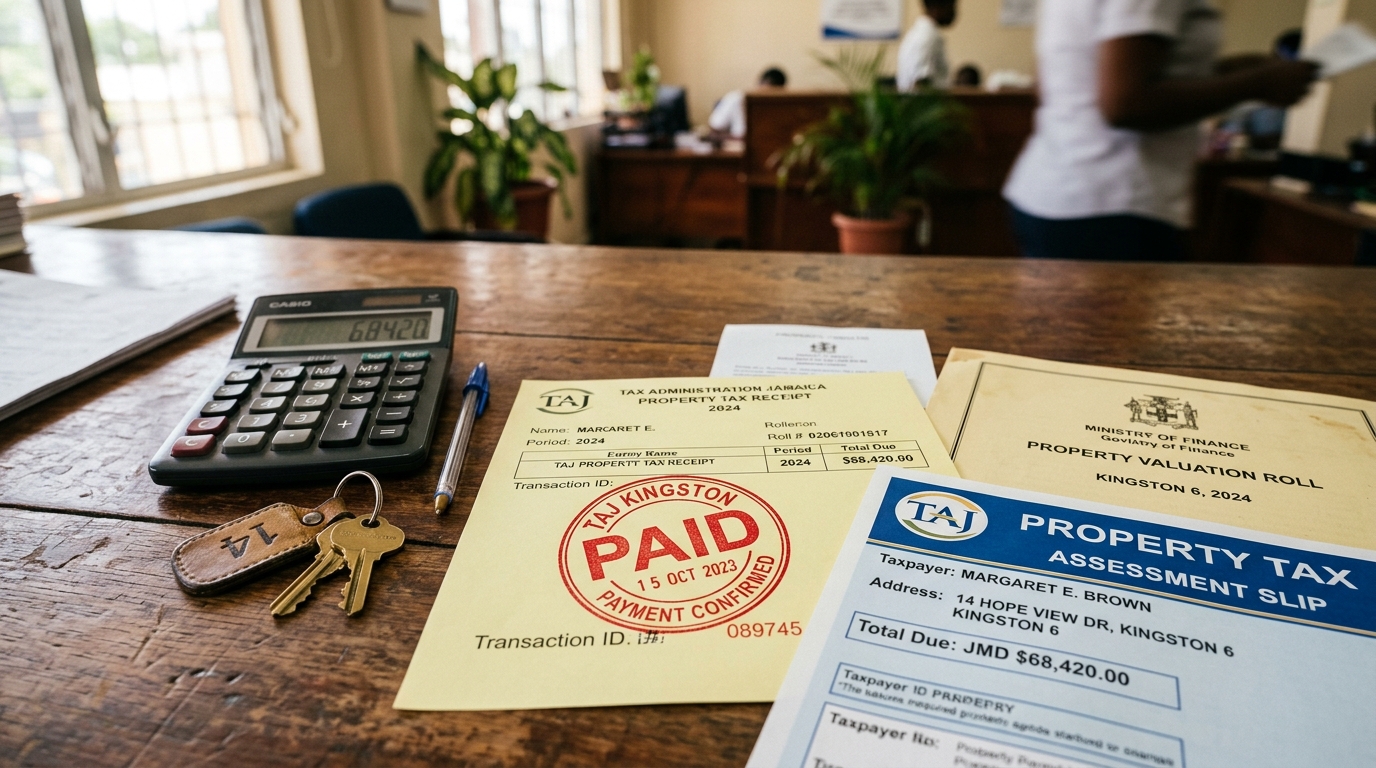
Stop compounding interest penalties and defend your property against squatter adverse possession. We locate your Valuation Number, audit your tax arrears with Tax Administration Jamaica, execute payment, and deliver official stamped receipts straight to your WhatsApp.
Thousands of Jamaican families living across North America and the United Kingdom own parcels of land, inherited family plots, or residential homes across the island. Yet for many overseas owners, one critical obligation is frequently overlooked until a crisis strikes: paying Jamaican property taxes.
Some owners assume that because they possess an old paper deed or Certificate of Title tucked away in a safe deposit box, their property is completely secure. Others attempt to pay through the government online portal, only to have their foreign credit card repeatedly declined due to international address verification errors.
Neglecting Jamaican property taxes carries serious financial and legal consequences. Unpaid balances incur automatic statutory interest penalties of 10% per annum. More critically, allowing taxes to lapse creates an open door for squatters, rogue tenants, or distant relatives to pay the taxes in their own names and attempt a legal takeover under the Jamaican Limitation of Actions Act (Adverse Possession).
This guide explains how property taxes are calculated in Jamaica, how to locate your Valuation Number from overseas, and how to verify and settle your balance safely.
How Property Tax Works in Jamaica
Property tax in Jamaica is an annual statutory tax levied on the unimproved value of the land, governed by the Property Tax Act and the Land Valuation Act. Unimproved value refers exclusively to the market value of the raw land itself, excluding buildings, crops, or structural improvements.
Every parcel of taxable land in the fourteen parishes is recorded on the national Valuation Roll, administered jointly by the National Land Agency (NLA) and Tax Administration Jamaica (TAJ).
Key Property Tax Facts:
- Due Date: Property taxes become legally due on April 1st of each year for the financial year (April 1 to March 31).
- Payment Options: Taxpayers can pay the full annual amount in April or pay in quarterly installments (due April 1, July 1, October 1, and January 1).
- Statutory Penalties: If taxes remain unpaid after the due date, TAJ applies an automatic statutory penalty, plus compounding interest of 10% per annum on the outstanding balance.
- Tax Collector Powers: Under Jamaican law, municipal revenue collectors have the legal power to issue court summonses, place liens on the property title, and in extreme cases of long-term delinquency, initiate forfeiture proceedings.
The Squatter Danger: Property Taxes and Adverse Possession
The most urgent reason to keep Jamaican property taxes current has nothing to do with government fines; it has everything to do with protecting your title against adverse possession.
Under Jamaica's Limitation of Actions Act, if an unauthorized occupant (such as a squatter, neighboring farmer, or disgruntled caretaker) occupies a property continuously, openly, and without the owner's permission for twelve consecutive years, the legal owner's right to recover the land is extinguished.
When a squatter files an application with the Supreme Court or the Registrar of Titles to claim ownership by adverse possession, one of the primary pieces of documentary evidence they submit is a consecutive stack of property tax receipts paid in their name.
If the municipal tax office shows that the registered owner has paid nothing for fifteen years while an occupant has dutifully paid the annual tax bill, the courts often view this as compelling proof of continuous dominion.
The Golden Rule for Diaspora Landowners:
Always ensure that property taxes are paid in the registered owner's name and maintain a digital and physical archive of every official TAJ stamped receipt. Never allow a caretaker or tenant to pay the land taxes under their personal name.
Finding Your 9-Digit Property Valuation Number
To check your tax balance or make a payment, Tax Administration Jamaica requires a unique nine-digit Valuation Number (also called a Tax Roll Number). This number is formatted with parish, district, and parcel codes, such as 024-05-012-045.
Where to Find Your Valuation Number:
- On a Previous Tax Receipt: Look at any historical blue or yellow paper receipt issued by a Jamaican Collectorate of Taxes.
- On an Assessment Notice: TAJ periodically issues white and blue Notice of Assessment slips to properties on the island.
- On Your Registered Certificate of Title: Modern Certificates of Title issued by the National Land Agency frequently list the Valuation Roll number in the title header or property description.
What if You Do Not Have the Valuation Number?
If you inherited land and only have a relative's name, an old unregistered indenture, or a Volume and Folio number, finding the Valuation Number requires an archival search. The National Land Agency's eLandJamaica cadastral database and municipal tax rolls must be searched using:
- The registered owner's full legal name
- The parish and district or postal town
- The property street address or identifiable landmark
- The Volume and Folio numbers from the Certificate of Title (if registered)
If you need help locating your title numbers first, review our guide on How to Find Volume and Folio Numbers in Jamaica.
The 3 Ways to Settle Jamaican Property Taxes from Overseas
Once you have your valuation details, you have three primary methods to settle your tax account.
Option 1: The TAJ Online Portal (taj.gov.jm)
Tax Administration Jamaica operates a public web portal where taxpayers can enter a valuation number and attempt payment via debit or credit card.
The Reality for Overseas Diaspora:
While convenient in theory, the online payment portal frequently rejects international cards issued in the US, UK, and Canada. The payment gateway enforces strict Caribbean banking security measures that often trigger address verification failures on foreign billing addresses. Beyond payment failures, the online receipt is a generic web printout that many Jamaican banks and attorneys refuse to accept without official collectorate validation stamps.
Option 2: Relying on Local Friends or Relatives
Many overseas owners send money via Western Union or remittance to a family member in Jamaica and ask them to stand in line at the local collectorate.
The Reality:
This often leads to miscommunication. Relatives may only pay a fraction of the bill, misplace the stamped paper receipts, or worse, have the cashier put the receipt in their own name. In family land disputes, having a relative's name on years of property tax receipts creates severe legal entanglements when probating wills or dividing parcels.
Option 3: Dedicated Concierge Service
This is the cleanest and most dependable option for overseas owners who need verified legal proof of payment.
With HowJamaica's Property Tax Concierge:
- Valuation Search: If you do not have your 9-digit number, we cross-reference municipal records, NLA cadastral mapping, and registered owner records to identify the exact tax parcel.
- Full Arrears Audit: We generate an official breakdown of all outstanding taxes, including accrued interest and statutory penalties.
- In-Person / Verified Settlement: We execute payment directly with Tax Administration Jamaica, ensuring the transaction is registered exclusively in the legal owner's name.
- Official Stamped Receipt Delivery: We obtain the stamped government receipt and Certificate of Payment from the collectorate and deliver high-resolution digital copies straight to your WhatsApp and email.
- Annual Protection: We track your property annually so taxes are paid every April, preventing arrears from snowballing.
Essential Situations Requiring Up-To-Date Tax Receipts
Maintaining current property tax records is mandatory for several major legal transactions:
- Selling Real Estate: Jamaican conveyancing attorneys cannot complete a sale without an official Property Tax Certificate confirming zero arrears.
- Applying for Registered Title: If you are bringing unregistered family land under the Registration of Titles Act (First Registration), the Registrar of Titles demands historical property tax receipts to prove continuous family possession.
- Estate Administration & Wills: Executors probating a deceased relative's estate must clear all municipal taxes before property can be transferred to heirs.
- Building Approvals: Parish Municipal Corporations will immediately reject architectural drawings and building permits if the underlying property taxes are unpaid.
Protect Your Jamaican Heritage Today
Your land is one of your most valuable assets. Do not let overdue property taxes or squatter claims put your family's investment at risk.
Whether you need to look up an unknown valuation number, audit twenty years of back taxes, or receive official stamped receipts for an attorney, our team in Jamaica is ready to assist.
Settle Your Jamaican Property Tax with Complete Peace of Mind
Fast, secure, and officially verified directly with Tax Administration Jamaica. Receive your stamped government receipts on WhatsApp.
View Property Tax Packages & Order Online →
Message on WhatsApp (+1 207-613-5240)
Own or Inherited Land in Jamaica? Verify Registered Title Records Online
Don't leave family property at risk of capture or boundary disputes. Our researchers pull official National Land Agency (NLA) records and send a plain-English report with a WhatsApp voice note within 48 hours. From $29.99 USD flat.
Check Land Title Records (From $29.99) →Join 5,000+ Jamaicans in the Diaspora 🇯🇲
Get daily Jamaican news breakdowns, live forex rate alerts, customs duty tips, and exclusive diaspora guides straight to your phone.